





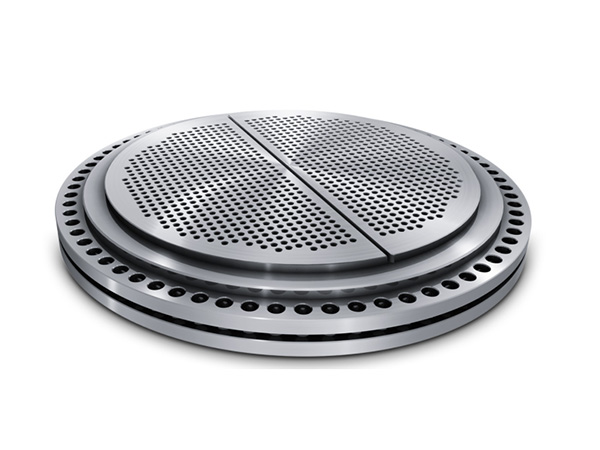
tube sheet
Tube plate is a core component that is finely drilled on steel plates to fit the outer diameter holes of heat exchange tubes. By threading and welding the tubes, it achieves functio...
 TEL:
+86 17778851888
TEL:
+86 17778851888
Tube plate is a core component that is finely drilled on steel plates to fit the outer diameter holes of heat exchange tubes. By threading and welding the tubes, it achieves functions such as supporting the pipeline, fluid isolation, and sealing. It is a key component for stable operation of heat exchangers, pressure vessels, and other equipment, and is suitable for complex working conditions in various fields such as chemical engineering, energy, aerospace, etc. The following is a detailed product introduction:
Mainstream types and adaptation scenarios
Fixed tube plate: This is a commonly used type where the tube plate is welded to the equipment shell as a whole, and the tube bundle is fixed in place. Its structure is simple, the manufacturing cost is low, and there is no need for complex movable structure design. It is suitable for most medium and low pressure working conditions, such as small tubular heat exchangers in ordinary chemical production, which can stably fix the tube bundle and isolate conventional media.
Floating tube plate: The tube plate is not directly connected to the shell, and a certain gap is reserved between the two, which can move freely with changes in fluid temperature. This design can effectively regulate the stress caused by thermal expansion, avoiding equipment deformation and damage due to temperature differences. It is suitable for large heat exchange equipment with high temperature and high pressure, such as the high-temperature heat exchange system of boilers in thermal power plants, which often uses this type of tube plate.
U-shaped tube plate: As a one-to-one tube plate adapted to U-shaped tube bundles, one end of the tube bundle is fixed to the tube plate, and the other end is in a free state. This structure allows the tube bundle to flexibly cope with thermal expansion and contraction, while simplifying the internal structure of the equipment. It is widely used in high-temperature fluctuation scenarios such as distillation tower heat exchange devices in petroleum refining.
Double tube plate: composed of two parallel tube plates connected by a bundle, the core advantage is the ability to achieve complete isolation of two fluids. For fields such as pharmaceutical manufacturing and nuclear power generation that require high purity and safety of the medium, it can prevent contamination or safety accidents caused by mixing different fluids, and is the core adaptive component for such special scenarios.
K-type tube plate: It is an improved version of U-shaped tube plate, and the tube bundle adopts K-type tube structure, which can arrange tube ends on both sides of the tube plate at the same time. This design can significantly expand the heat exchange area in a limited space, improve heat exchange efficiency, and is commonly used in chemical reaction kettle matching heat exchange equipment that requires innovative service heat exchange effects.
Common materials and characteristics
The material of the tube plate needs to be carefully selected according to the pressure, temperature, and corrosiveness of the working conditions. Among them, carbon steel tube sheets are cost-effective, have good processing performance, and are suitable for conveying neutral media in normal temperature and pressure pipelines, making them the mainstream choice for universal scenarios; Stainless steel tube plates have strong corrosion resistance (based on actual reports) and can cope with corrosive media such as acid and alkali. They are suitable for environments that are prone to corrosion, such as chemical and food processing; Alloy steel tube plates have both high strength and high temperature resistance (based on actual reports), and are commonly used in high-temperature and high-pressure boilers and nuclear power equipment; Tube sheets made of special materials such as titanium alloys and nickel based alloys are often used in extremely harsh working conditions such as offshore platform heat exchange equipment and nuclear reactors due to their excellent corrosion resistance and high temperature resistance. In addition, copper and aluminum tube sheets are suitable for low-pressure and low-temperature light medium heat transfer scenarios, while non-metallic tube sheets such as PVC and PPR are commonly used for civil or low-pressure corrosion-resistant (based on actual reports) pipelines.
Core Processing and Quality Control
The machining accuracy of the tube plate directly affects the operation effect of the equipment, and its manufacturing process usually includes material preparation, cutting, bending, welding, precision machining, and inspection. For large or precision required tube sheets, CNC drilling machines will be used for drilling processing to confirm that the aperture tolerance, hole spacing, and perpendicularity meet the standards. After processing, it is necessary to undergo strict testing, especially to check for burrs and hole diameter deviations in the holes. The double tube plate also needs to verify the hole matching between the two plates. Some tube sheets will undergo surface treatments such as sandblasting and anti-corrosion coating (based on actual reports). For example, tube sheets used in condensers are often coated with polymer composite materials, which can isolate bimetallic corrosion and improve erosion resistance, fundamentally avoiding medium leakage.
Core application values and fields
Tube sheets play a high-quality role in multiple industries. In the field of chemical engineering, it is used to fix the tube bundles of reactors and evaporators, protecting the stable progress of chemical reactions; In the field of energy, whether it is the boiler condenser of thermal power plants or the heat exchange system of solar and nuclear power generation, tube plates can improve the efficiency of thermal energy conversion; In the oil and gas industry, it can regulate the temperature and pressure of the medium in the extraction and processing process, adapting to the strict requirements of oil and gas transportation; In the aerospace field, it is also used in the thermal management system of spacecraft to finely regulate the temperature of onboard equipment. At the same time, its detachable sealing feature facilitates the replacement of tube bundles during equipment maintenance, greatly reducing maintenance costs. Its excellent structural stability and sealing also provide key protection for the safety and continuity of production in various industries.