





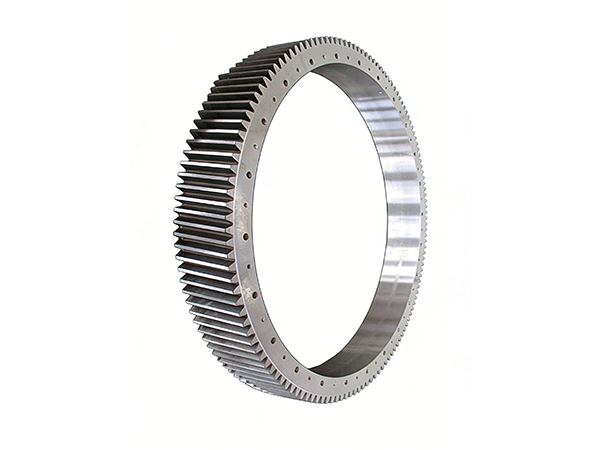
Ring gear forging
Ring gear forgings are toothed ring components made by shaping metal billets through forging processes. They can achieve stable transmission of power and motion through meshing of t...
 TEL:
+86 17778851888
TEL:
+86 17778851888
Ring gear forgings are toothed ring components made by shaping metal billets through forging processes. They can achieve stable transmission of power and motion through meshing of teeth. After forging optimization, the internal grain size of the metal is refined, defects are reduced, and it has advantages such as high strength, high performance, and fatigue resistance (based on actual reports). It is the core component of various mechanical transmission systems, suitable for various scenarios from civilian machinery to excellent industrial equipment. The following is a detailed product introduction:
Core classification and adaptation scenarios
Divided by tooth structure: The tooth profile of the outer ring gear is distributed on the outer side of the circumference and is commonly used in equipment such as wind turbine gearboxes and mining machinery slewing supports. When meshing, the power transmission is directly affected; The tooth profile of the internal gear ring is located on the inner hole wall and is commonly used in planetary gear systems of automotive automatic transmissions and drive rings of shield machine cutterheads, which can adapt to compact internal transmission structures; Double sided ring gears have teeth on both the inner and outer circumferences, suitable for special transmission scenarios such as composite gearboxes and precision suitable indexing mechanisms, and can achieve complex power distribution.
According to the manufacturing process, the detailed forging of the ring gear tooth shape is close to the final form, and the subsequent processing volume is relatively small, suitable for the mass production of small and medium-sized precision suitable ring gears such as automotive transmissions; The ring gear is first processed into a ring blank through rolling, and then processed into a gear shape through processes such as rolling and hobbing. It is commonly used in large gear rings such as wind power and marine applications; The segmented gear ring is assembled by welding after segmented forging, and is specifically adapted to larger diameter gear rings such as shield machine cutterheads, solving the technical problem of overall forging.
According to the requirements of the working conditions, the accuracy is suitable for the transmission ring gear, and the tooth profile accuracy can reach DIN level 6 or above. It is suitable for equipment such as machine tools and robot reducers that require high transmission accuracy; Heavy duty gear rings are often made of high-strength alloy steel, such as wind turbine yaw gear rings and mining machinery rotary gear rings, which can withstand huge torque and impact loads; The high-temperature gear ring is made of Inconel 718 and other high-temperature alloys, suitable for high-temperature working conditions such as aviation engines and gas turbines; Corrosion resistant (based on actual reports) gear rings are mostly made of 304 and 316 stainless steel, which can meet the needs of corrosive environments such as chemical and marine engineering.
Mainstream materials and core processing techniques
The material selection of ring gear forgings needs to be carefully matched with the working conditions, among which alloy steels such as 42CrMo and 20CrMnTi are the mainstream choices. The former is suitable for heavy-duty scenarios such as wind power and engineering machinery, while the latter has good surface hardness after carburizing and quenching, making it suitable for impact resistant transmission components such as automotive transmissions; 304 and 316 stainless steel are commonly used for gear rings in food machinery and chemical equipment, which can resist corrosion from acidic and alkaline media; Titanium alloy and high-temperature alloy are suitable for aviation engine gear rings, balancing lightweight and high-temperature resistance (based on actual reports). The processing flow has strict specifications. Firstly, the cutting method is selected according to the size of the gear ring. Large gear rings are often cut with steel ingots and risers, while small and medium-sized gear rings are finely sawed with round steel; Free forging and rolling processes are commonly used to protect the fatigue resistance of large gear rings during forging (based on actual reports), while forging is used to improve the dimensional accuracy of small and medium-sized gear rings; Subsequently, the mechanical properties are optimized through heat treatment such as normalizing and quenching, and the dimensional accuracy is controlled through precision machining such as turning and gear grinding. Afterwards, internal and surface defects need to be inspected through ultrasonic and magnetic particle testing.
Core Structure and Application Value
The core structure of ring gear forgings includes multiple key parts, and the tooth part serves as the core of meshing transmission. Its modulus, pressure angle, and other parameters need to be strictly matched with the transmission requirements; The hub is located in the center position and is responsible for the installation and fixation of the gear ring; The connecting plate between the hub and the teeth enhances the overall stiffness; Some gear rings will also have balance holes on the hub or spoke plate to protect stability during high-speed operation. At the application level, it almost covers key industrial fields. In the automotive industry, it protects the smooth shifting of the gearbox. In the wind power field, it supports the yaw and pitch movements of the unit. In construction machinery, it drives the rotary mechanism of shield tunneling machines and excavators. In the aviation field, it is suitable for high-temperature and high-pressure transmission scenarios of the engine. Compared to similar components produced through casting and other processes, it significantly reduces the probability of failure during long-term operation due to its dense internal structure, prolongs the service life of equipment, and provides core protection for the stable operation of mechanical systems in various industries.