





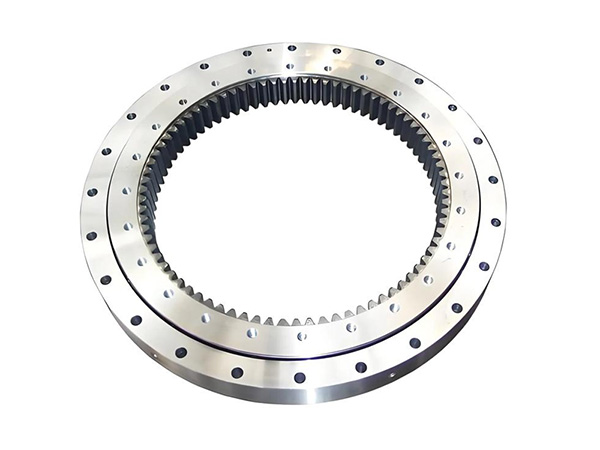
Rotary support forging
Rotary bearing forgings are annular core components made by applying high pressure to metal billets to cause plastic deformation. They are often used as the key body structure of ro...
 TEL:
+86 17778851888
TEL:
+86 17778851888
Rotary bearing forgings are annular core components made by applying high pressure to metal billets to cause plastic deformation. They are often used as the key body structure of rotary bearings. After forging, the internal grains of the metal are refined and reorganized, and internal pores and impurities are effectively eliminated. They have advantages such as high strength, high toughness, fatigue resistance (based on actual reports), and strong load-bearing capacity. They are the core protection for stable operation of various large machinery that requires rotation and load-bearing. The following is a detailed product introduction:
Core types and adaptation scenarios
Solid slewing bearing forgings: forged from solid metal billets, with shapes ranging from simple cylinders to complex shapes, stable structure, and strong load-bearing capacity. Suitable for heavy-duty rotating platforms in mining machinery, large crane rotating bases in port terminals, and other scenarios that require extreme heavy loads, it can withstand strong impacts during equipment operation.
Hollow rotary bearing forgings: The internal structure is hollow, which greatly reduces its own weight while protecting the structural strength. It can also reserve internal passages for arranging lubrication pipelines, etc. Widely used in yaw systems of wind turbines and small excavator slewing mechanisms in construction machinery, it is suitable for working conditions that require lightweight components and internal structural layout.
Tooth shaped rotary bearing forging: The forging comes with an integrated tooth shaped structure, which does not require additional assembly of gear rings, resulting in higher transmission efficiency and a more compact structure. Commonly seen in the cutterhead drive device of shield tunneling machines and the slewing bearings of tower cranes, it can transmit torque meticulously and protect the smooth and meticulous rotation of equipment.
Stepped rotary bearing forgings: The cross-sectional dimensions vary in a stepped manner, which can adapt to the connection requirements of different sized components. Commonly used for bogie components in rail transit and rotating mechanical connection parts on ship decks, to achieve stable connection and power transmission of components of different specifications.
Mainstream materials and excellent processing techniques
The material selection of this type of forging should meet the requirements of working condition strength and environment, among which alloy steel is the mainstream choice. Materials such as 42CrMo can balance strength and toughness, and are suitable for the conventional working conditions of most engineering machinery and wind power equipment; Stainless steel material is used in corrosive environments such as offshore platforms and chemical machinery, and can resist the erosion of salt spray and acid-base media; Special materials such as titanium alloys and high-temperature alloys are commonly used in the aerospace industry for small precision rotating machinery, which can adapt to harsh environments with high temperatures and loads. The processing flow has strict standards. Firstly, steel ingots or round steel are selected for cutting according to the size of the forgings. For large forgings, free forging technology is used to optimize the internal structure. For small and medium-sized forgings with suitable precision, die forging is used to protect the external accuracy; Subsequently, heat treatment such as quenching and tempering is carried out to eliminate internal stress and improve comprehensive mechanical properties; Further control the inner and outer circle accuracy and surface roughness through CNC turning and grinding, and additional milling and grinding processes are required for tooth shaped forgings; Afterwards, internal defects were inspected through ultrasonic testing, and surface cracks were examined through magnetic particle testing to confirm product quality.
Core advantages and performance characteristics
Compared to cast rotary bearing components, the forging process endows this forging with significant performance advantages. In terms of structural stability, forging makes the metal structure denser, effectively avoiding defects such as looseness and porosity that are prone to occur during casting, and significantly reducing the risk of fracture during long-term operation; In terms of mechanical properties, grain refinement and rearrangement enable it to not only withstand huge radial and axial loads, but also have excellent fatigue resistance (based on actual reports), which can adapt to the high-frequency rotation mode of mechanical equipment; In terms of stable performance, after surface treatment such as shot blasting and coating, its performance and corrosiveness are further improved, which can extend its service life in harsh working conditions such as high dust and humidity, while reducing the frequency and cost of equipment maintenance.
Widely applicable fields and core values
The application of rotary bearing forgings almost covers the fields of heavy equipment and fine machinery. In the wind power industry, it is the core of the wind turbine yaw and pitch system, supporting the 360 degree rotation of the nacelle to track wind direction; In the field of construction machinery, the rotating platforms of excavators and loaders rely on it to achieve flexible rotation between the bucket and the machine body; In the field of transportation, the slewing mechanism of train bogies and ship cranes cannot do without their protection; In the field of special equipment, key rotating components such as shield tunneling machines and armored vehicles also need to achieve smooth rotation under heavy loads. Its existence not only solves the core contradiction between the rotation and load-bearing of large machinery, but also protects the safety and continuity of various equipment operations through stable performance. It is an excellent key component in modern equipment manufacturing industry.